
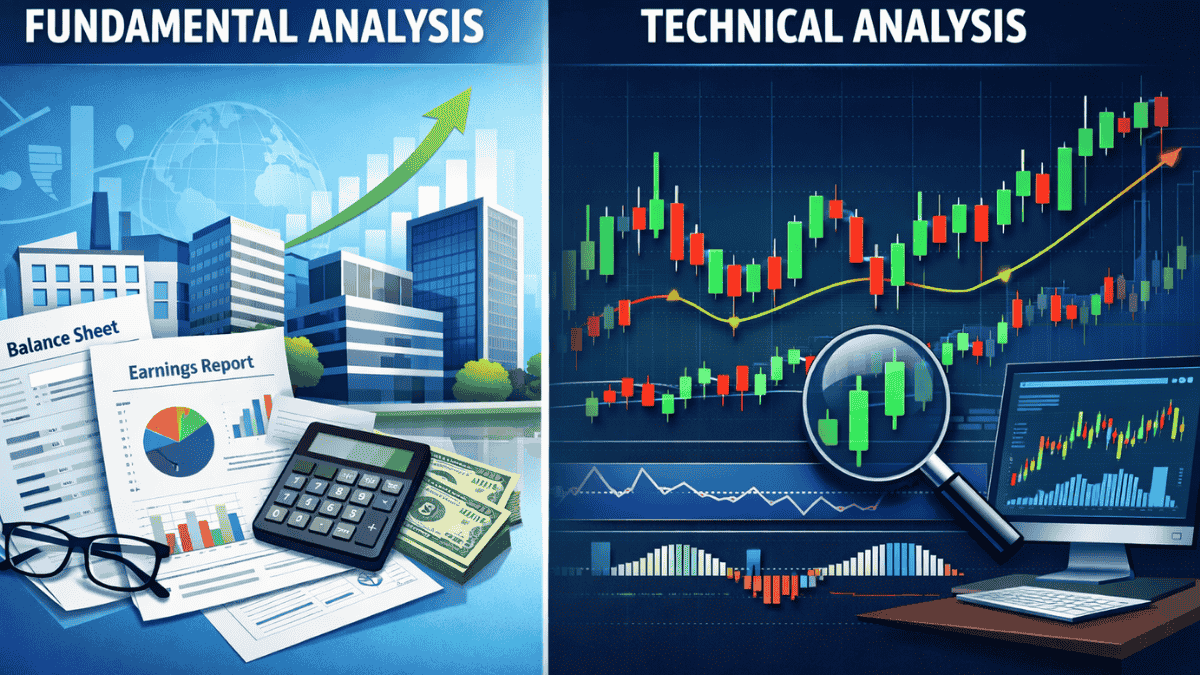
In 2026, investors are more confused than ever.
AI-driven trading, high volatility, global interest rate shifts, and retail participation at record highs — all raise one big question:
👉 Fundamental vs Technical Analysis: Which is better in 2026?
Some investors swear by balance sheets and earnings.
Others trust charts, patterns, and indicators.
But in a fast-moving, data-heavy market like 2026, choosing the wrong approach can cost you money — and choosing the right one can multiply your returns.
Let’s break it down clearly, practically, and future-focused.
Table of Contents
1️. What Is Fundamental Analysis?
Fundamental Analysis is a method of evaluating a stock or company by studying its financial health, business performance, and future growth potential. It focuses on factors like revenue, profits, debt, cash flow, management quality, industry trends, and overall economic conditions. Investors use fundamental analysis to find out whether a stock is undervalued or overvalued compared to its real worth. This approach is mainly used for long-term investing, as it helps identify strong companies that can grow steadily over time and deliver consistent returns despite short-term market fluctuations.
Fundamental analysis focuses on a company’s real value.
It answers questions like:
- Is this business profitable?
- Is revenue growing?
- Is debt under control?
- Does the company have a future?
Core Elements of Fundamental Analysis:
- Financial statements (Balance Sheet, P&L, Cash Flow)
- Earnings growth
- Debt-to-equity ratio
- Valuation metrics (P/E, P/B, PEG)
- Industry & economic trends
- Management quality
📌 Example:
An investor studies Tata Motors’ EV expansion, global demand, margins, and debt reduction before investing.
2️. What Is Technical Analysis?
Technical analysis is a widely used trading approach that studies market activity data, mainly price movements and trading volume, to identify potential investment opportunities. Traders rely on charts, patterns, and technical indicators to understand market trends and predict future price behavior. The primary goal of technical analysis is to determine optimal entry and exit points, helping traders manage risk and improve timing.
Unlike fundamental analysis, technical analysis does not focus on a company’s financial performance, earnings, or sales. Instead, it is based on the belief that all available information is already reflected in the market price. This method is especially popular among short-term traders, including intraday and swing traders, because it helps them react quickly to changing market conditions. By analyzing historical price data and volume trends, technical analysis allows traders to make informed decisions without studying a company’s underlying business fundamentals.
Technical analysis focuses on price and volume data, not company fundamentals.
It answers questions like:
- When should I enter?
- When should I exit?
- Is momentum strong or weak?
Common Technical Tools:
- Candlestick patterns
- Support & resistance
- RSI, MACD
- Moving averages
- Trendlines
- Chart patterns
📌 Example:
A trader buys Reliance Industries after a breakout above resistance with strong volume.
3️. Why This Debate Matters More in 2026
Markets in 2026 are not like the past.
Key 2026 Market Characteristics:
- AI & algorithmic trading dominance
- Faster news impact
- Shorter market cycles
- Retail investors with real-time data
- Higher volatility
Because of this, the Fundamental vs Technical Analysis debate is more important than ever.
Relying only on one method may not be enough anymore.
Also Read : Best AI Stocks for the Next 10 Years (2025–2035 Guide)
4️. Fundamental Analysis in 2026: Strengths & Limits
✅ Strengths
✔ Best for long-term wealth creation
✔ Helps identify undervalued stocks
✔ Works well for retirement & SIP investors
✔ Less affected by daily market noise
❌ Limitations
✖ Entry timing can be poor
✖ Stocks may stay undervalued for long
✖ Slow reaction to sudden events
✖ Requires patience
📌 In 2026, fundamentals still build conviction, but timing matters more than before.
5️. Technical Analysis in 2026: Strengths & Limits
✅ Strengths
✔ Excellent for timing entries & exits
✔ Works well in volatile markets
✔ Ideal for swing & intraday trading
✔ Faster decision-making
❌ Limitations
✖ No insight into business quality
✖ False breakouts possible
✖ Emotional trading risk
✖ Not ideal alone for long-term investing
In 2026, technical analysis thrives because price reacts before fundamentals are visible.
6️. Fundamental vs Technical Analysis: Key Differences
| Factor | Fundamental Analysis | Technical Analysis |
| Focus | Business value | Price & trends |
| Timeframe | Long-term | Short-term to medium |
| Data Used | Financials, economy | Charts, indicators |
| Best For | Investors | Traders |
| Risk | Lower (long-term) | Higher if misused |
This comparison highlights why Fundamental vs Technical Analysis is not about right or wrong — it’s about purpose.
7️. Which Is Better for Long-Term Investors in 2026?
👉 Fundamental analysis wins for long-term investors.
Why?
- Strong businesses survive volatility
- Earnings growth compounds wealth
- SIP investors benefit from valuation comfort
Best Strategy:
- Use fundamental analysis to select stocks
- Use basic technicals for better entry
📌 Example:
Choose fundamentally strong IT stock → enter near 200-day moving average support.

8️. Which Is Better for Traders in 2026?
👉 Technical analysis dominates for traders.
Why?
- Speed matters
- Price reacts before news
- Risk management is crucial
But traders in 2026 still check:
- Earnings dates
- Major announcements
- News events
📌 Pure chart trading without awareness can be risky.
9️. How Smart Investors Use Both in 2026
The real winners in 2026 don’t choose sides.
They combine both.
Hybrid Strategy (Best for 2026):
- Fundamental analysis → What to buy
- Technical analysis → When to buy & sell
- Risk management → How much to invest
📌 This approach reduces risk and improves returns.
That’s why many experts say:
“Fundamental vs Technical Analysis is outdated — synergy is the future.”
2026 Market Prediction Insight
With AI trading, geopolitical risks, and economic cycles:
- Fundamentals build confidence
- Technicals give precision
Ignoring either can put you at a disadvantage.
10. Final Verdict: Which Is Better in 2026?
✅ Short Answer:
Neither alone is best. Both together win.
Clear Recommendation:
- Long-term investors → Fundamental + simple technicals
- Swing traders → Technical + basic fundamentals
- Beginners → Start with fundamentals, learn charts slowly
In the Fundamental vs Technical Analysis debate for 2026, the smartest move is balance.
11. FAQs
Q1. Is fundamental analysis still relevant in 2026?
Yes. Strong fundamentals remain the backbone of long-term investing.
Q2. Can beginners use technical analysis?
Yes, but start with simple indicators and strict risk control.
Q3. Which is better for the Indian stock market?
A combination of both works best in India’s volatile market.
Q4. Can I invest using only charts?
Possible, but risky without understanding the business.
Q5. What do professionals use in 2026?
Most professionals use both fundamental and technical analysis together