

Most investors lose money in the stock market not because they choose bad stocks—but because they do not know how to analyze stocks for long-term investment properly. In 2026, markets are faster, noisier, and more emotional than ever. If you want real wealth, not short-term excitement, mastering long-term stock analysis is non-negotiable.
This guide breaks stock analysis into simple, practical steps that even beginners can follow—without complication.
Table of Contents
1. What Is Long-Term Stock Investment?
Long-term investment means putting money into assets like stocks, mutual funds, or bonds and holding them for 5 years or more to benefit from growth and compounding. also buying shares of strong companies and holding them for 5, 10, or even 20 years. The goal is to benefit from:
- Business growth
- Profit compounding
- Dividend reinvestment
- Market expansion
Why Long-Term Investment Is Important
- Builds wealth steadily
- Reduces market risk
- Takes advantage of compounding
- Less stress than short-term trading
- Lower tax impact in many countries
Best Options for Long-Term Investment
| Investment Type | Risk Level | Ideal Duration |
|---|---|---|
| Stocks | High | 5–10+ years |
| Equity Mutual Funds | Medium–High | 5+ years |
| Index Funds | Medium | 7–15 years |
| ETFs | Medium | 5–10 years |
| Bonds | Low–Medium | 3–7 years |
| Gold | Medium | 5+ years |
| Real Estate | Medium | 10+ years |
When you understand how to analyze stocks for long-term investment, short-term market volatility becomes irrelevant.
2. Why Long-Term Analysis Beats Short-Term Trading
Long-term analysis consistently outperforms short-term trading because it focuses on business growth, compounding, and time, not market noise. Data across global markets proves that patient investors win more often.
1. Power of Compounding (Real Data)
- A 12% annual return doubles money in ~6 years
- ₹1 lakh invested for 20 years at 12% becomes ₹9.6 lakh
- Traders rarely benefit from compounding due to frequent exits
📊 Data Insight:
Over 90% of wealth created in equities comes from long holding periods, not frequent trades.
2. Market Timing Failure Rate
- Studies show 80–90% of traders fail to consistently time the market
- Missing just the best 10 days in the market can reduce returns by 40–60%
📉 Long-term investors stay invested and capture those best days automatically.
| Long-Term Investing | Short-Term Trading |
| Lower stress | High emotional pressure |
| Less brokerage & tax | High costs |
| Power of compounding | Limited growth |
| Business-focused | Price-focused |
3. Step 1: Understand the Business Model
A business model explains how a company makes money, delivers value to customers, and sustains profits over time Before numbers, understand the story.
Ask:
- What product or service does the company sell?
- Who are its customers?
- Is demand growing or shrinking?
- Can a 10-year-old understand this business?
Why Business Model Is Important for Investors
For long-term investment, the business model helps you judge:
- Sustainability of profits
- Growth potential
- Risk level
- Competitive strength
Key Parts of a Business Model
| Component | Meaning |
|---|---|
| Product/Service | What the company offers |
| Target Customers | Who buys it |
| Revenue Source | How money comes in |
| Cost Structure | Major expenses |
| Profit Margin | Earnings after costs |
| Competitive Advantage | Why customers choose it |
Strong business model = higher chance of long-term success.
If you can not explain the business simply, do not invest.
👉 Example: FMCG, banking, IT services, EVs, renewable energy.
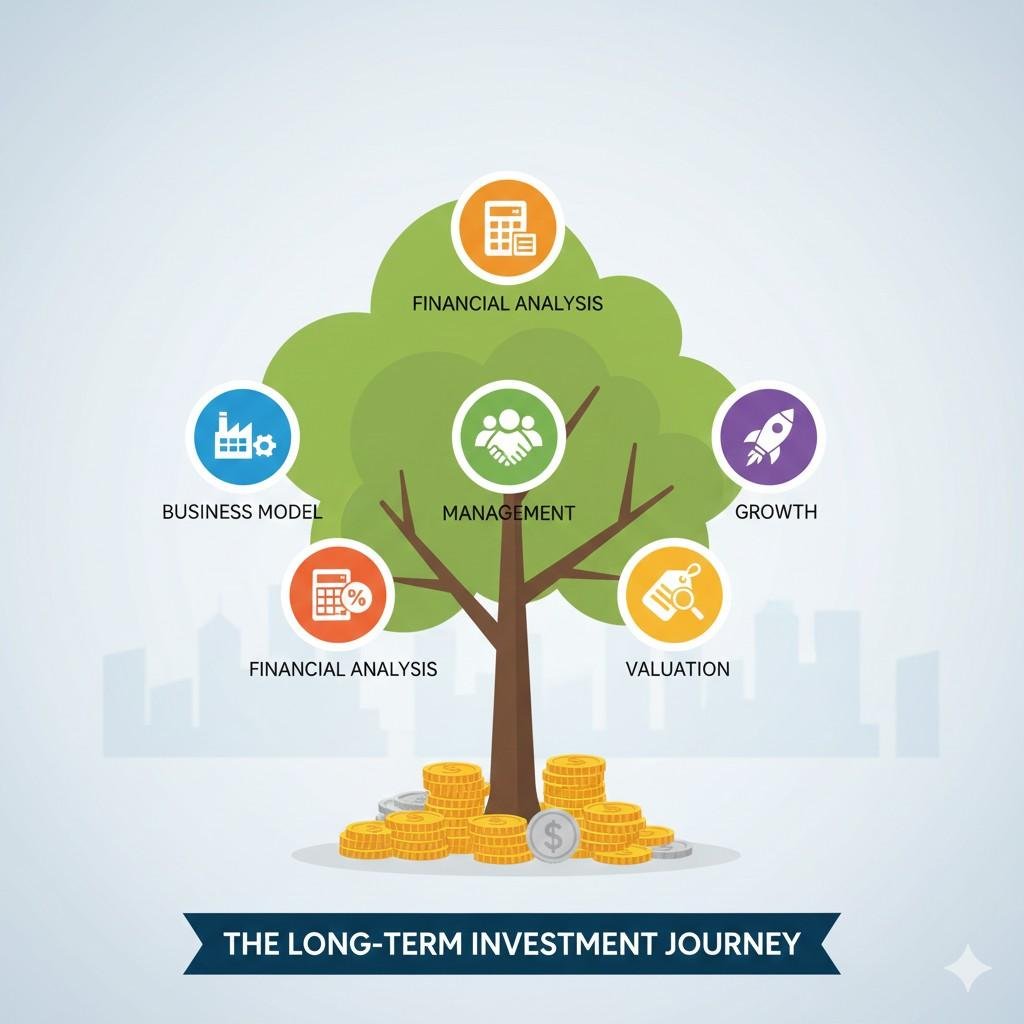
4. Step 2: Analyze Financial Statements
This is the backbone of how to analyze stocks for long-term investment.
Key Statements to Study:
- Income Statement – Revenue & profit growth
- Balance Sheet – Assets, liabilities, debt
- Cash Flow Statement – Real cash generation
📌 Look for consistent growth over 5–10 years, not one-year spikes.
5. Step 3: Check Key Financial Ratios
Important ratios simplify complex data.
Must-Check Ratios:
- ROE (Return on Equity) – Above 15% is strong
- Debt-to-Equity – Lower is safer
- EPS Growth – Consistency matters
- Operating Margin – Shows efficiency
- Free Cash Flow – Indicates real strength
Strong ratios = strong long-term foundation.
6. Step 4: Study Management & Corporate Governance
Even a great business can fail under bad leadership.
Check:
- Promoter shareholding (stable or increasing)
- Past track record
- Transparency in annual reports
- Related-party transactions
Long-term investors trust management first, numbers second.
7. Step 5: Competitive Advantage (Economic Moat)
An economic moat protects profits from competitors.
Types of Moats:
- Brand power (Example: Apple, Asian Paints)
- Cost advantage
- Network effect
- Regulatory barriers
Companies with strong moats survive decades.

8. Step 6: Industry & Macro Analysis
Understanding the environment is crucial in how to analyze stocks for long-term investment.
Analyze:
- Industry growth rate
- Government policies
- Technological disruption
- Global demand trends
📈 2026 Focus Sectors:
- AI & Automation
- Green energy
- Defense
- Infrastructure
- Healthcare
9. Step 7: Valuation – Is the Stock Worth Buying?
A great company at the wrong price gives poor returns.
Valuation Tools:
- P/E Ratio (compare with industry)
- PEG Ratio
- Price-to-Book
- Discounted Cash Flow (DCF)
Never overpay—even for quality.
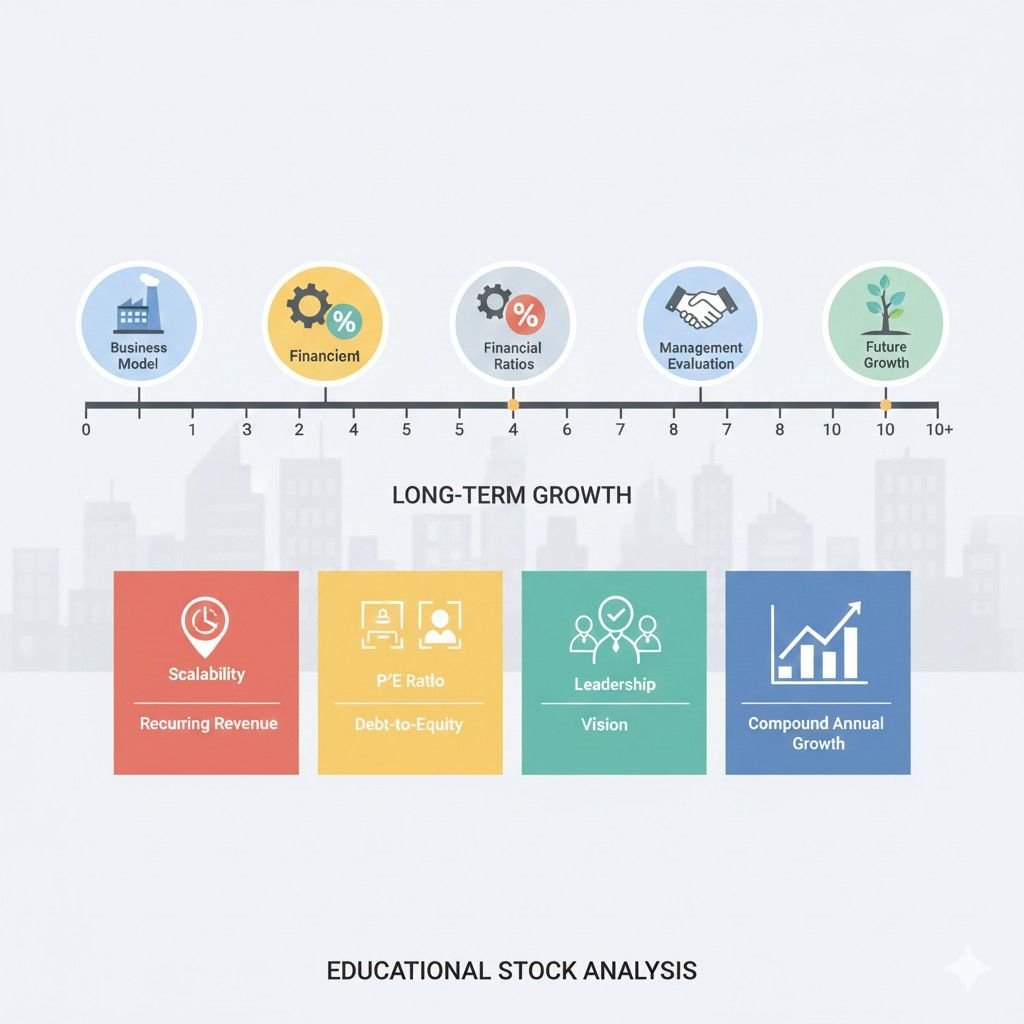
10. Step 8: Growth Triggers for the Next 5–10 Years
Ask:
- New product launches?
- Market expansion?
- Export growth?
- Capacity expansion?
- Government incentives?
Long-term wealth is created by future growth, not past success.
11. Common Mistakes to Avoid
❌ Buying stocks based on tips
❌ Ignoring debt levels
❌ Chasing hype stocks
❌ Over-diversification
❌ Panic selling during corrections
Understanding how to analyze stocks for long-term investment helps avoid these traps.
12. Final Verdict
Learning how to analyze stocks for long-term investment is the most powerful financial skill you can build in 2026. Markets will rise and fall, but strong businesses continue to grow. Focus on fundamentals, stay patient, and let compounding do the heavy lifting.
Long-term investing is not about timing the market—it is about time in the market.
13. FAQs
Q1. How much time should I hold a stock for long-term?
Ideally 5–10 years or more, as long as fundamentals remain strong.
Q2. Can beginners analyze stocks themselves?
Yes. Start simple—business model, revenue growth, and debt.
Q3. Is technical analysis needed for long-term investing?
Not mandatory. Fundamentals matter more.
Q4. How many stocks should a long-term portfolio have?
Between 8–15 quality stocks is ideal.
Q5. Should I invest during market crashes?
Yes—crashes offer the best long-term opportunities.