
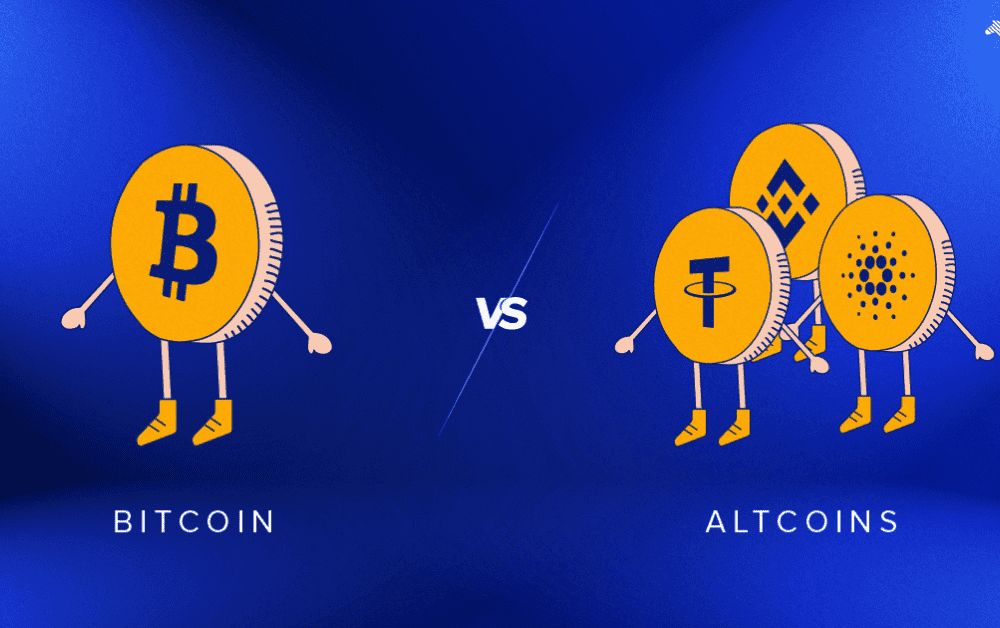
If you are new to crypto, chances are you have heard people say,
“Just buy Bitcoin—it is the safest,” while others argue,
“Altcoins give better returns.”
This creates confusion for beginners and even intermediate investors.
So what is the real difference between Bitcoin and altcoins?
Why does Bitcoin dominate the crypto market, and why do altcoins still attract millions of investors?
In this detailed guide, I break down the difference between Bitcoin and altcoins explained in simple language, no hype, just clear facts, real examples, and future insights.
Table of Contents
1. What Is Bitcoin?
Bitcoin is the first decentralized cryptocurrency, launched in 2009 by Satoshi Nakamoto. It has a fixed supply of 21 million coins, making it scarce like digital gold. Bitcoin operates on a secure blockchain network and is widely used as a store of value and hedge against inflation.
Its main purpose was simple:
- Create digital money
- Remove banks and middlemen
- Enable peer-to-peer transactions
Bitcoin operates on a decentralized blockchain, meaning no single authority controls it.
Key features of Bitcoin:
- Fixed supply of 21 million coins
- Highly secure network
- Most trusted cryptocurrency globally
2. What Are Altcoins?
Altcoins are all cryptocurrencies other than Bitcoin. The term “altcoin” stands for “alternative coin,” and these digital assets were created to improve or expand upon Bitcoin’s limitations. Altcoins often offer faster transaction speeds, lower fees, smart contract functionality, and support for decentralized applications.
Popular examples include Ethereum, Solana, Cardano, and Binance Coin. Many altcoins focus on specific use cases such as DeFi, NFTs, gaming, or cross-border payments. While altcoins can deliver higher growth potential than Bitcoin, they also carry greater risk due to market volatility, competition, and evolving regulations.
Altcoins were created to:
- Improve Bitcoin’s limitations
- Offer faster transactions
- Introduce smart contracts
- Support decentralized apps (dApps)
Examples of popular altcoins:
- Ethereum (ETH)
- Solana (SOL)
- Cardano (ADA)
- Binance Coin (BNB)
- Ripple (XRP)
Understanding this is crucial to grasping the difference between Bitcoin and altcoins explained clearly.
3. Why Bitcoin Was Created
Bitcoin was created in 2009 to provide a decentralized alternative to traditional financial systems after the global financial crisis of 2008. The goal was to remove the need for banks and intermediaries, allowing people to send money directly to each other.
Bitcoin offers transparency, security, and resistance to censorship. With a fixed supply of 21 million coins, it was also designed to protect wealth from inflation and currency devaluation.
Its core goals:
- Financial freedom
- Protection against inflation
- Censorship-resistant money
Bitcoin behaves more like digital gold than traditional currency.
4. Why Altcoins Exist
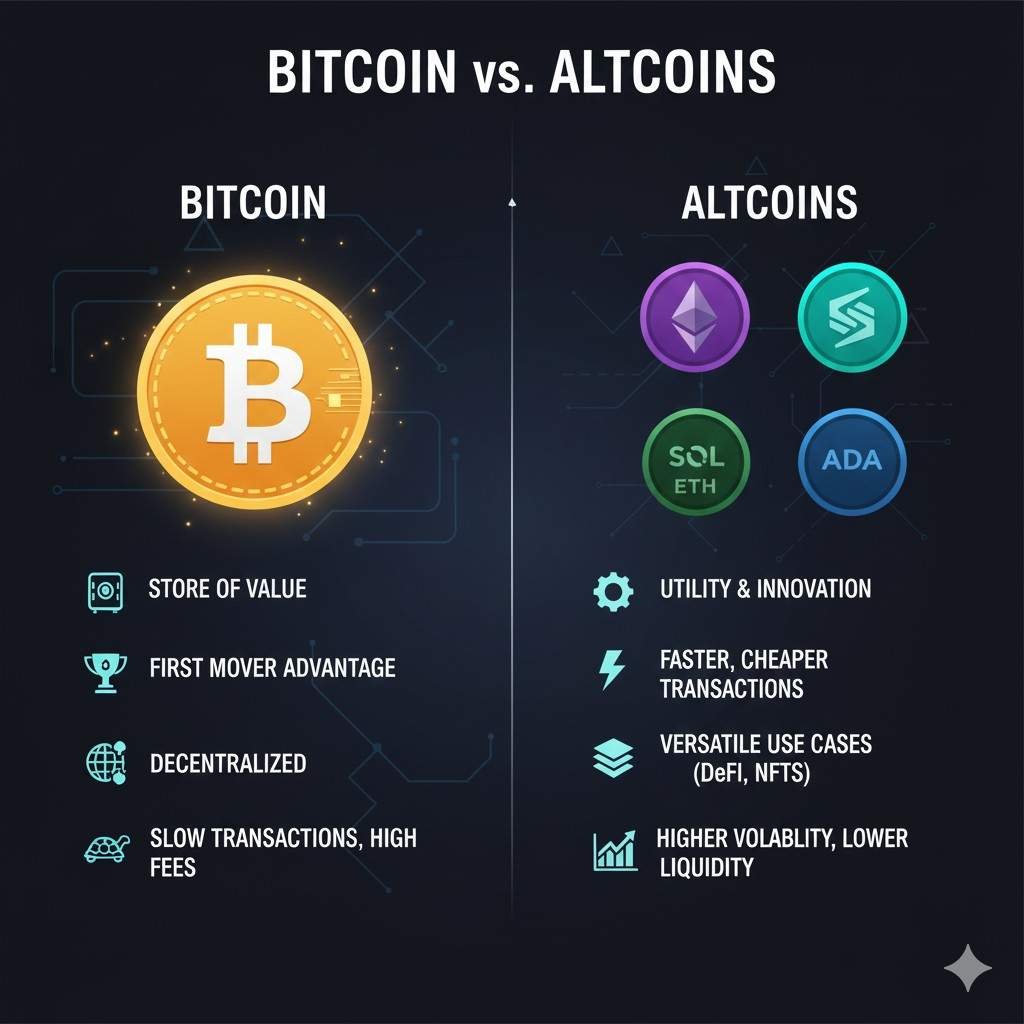
Altcoins exist to address the limitations of Bitcoin and expand blockchain technology beyond simple digital payments. While Bitcoin focuses on security and scarcity, altcoins introduce features like smart contracts, faster transactions, lower fees, and energy-efficient consensus models.
Many altcoins are designed for specific use cases such as decentralized finance, NFTs, gaming, and enterprise solutions. By experimenting with new technologies and ideas, altcoins drive innovation across the crypto ecosystem and help blockchain adoption grow in different industries.
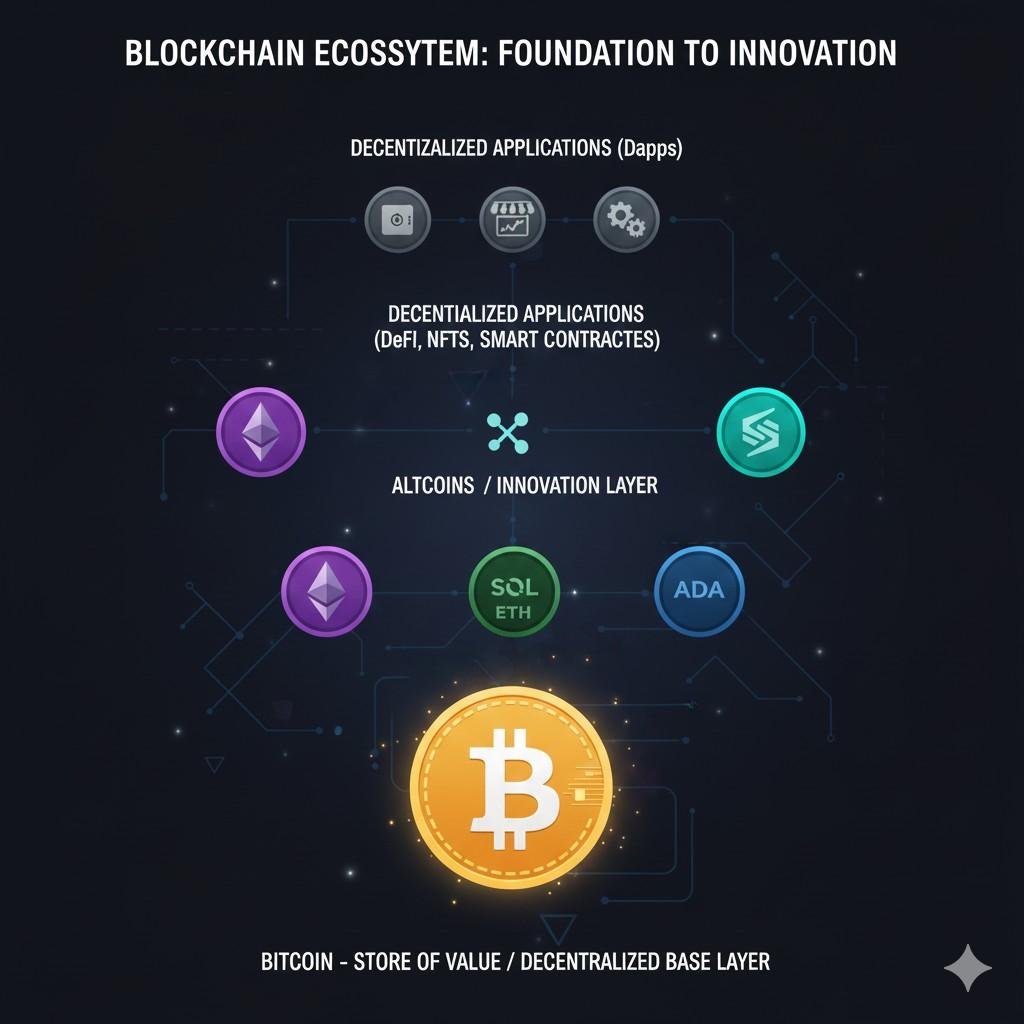
Altcoins were not created to replace Bitcoin but to expand blockchain use cases.
Problems altcoins tried to solve:
- Slow Bitcoin transactions
- Limited programmability
- High fees during congestion
Ethereum, for example, introduced smart contracts, enabling DeFi, NFTs, and Web3 applications.
Also Read : Which Crypto to Buy During Market Crash
5. Core Difference Between Bitcoin and Altcoins Explained
The core difference between Bitcoin and altcoins lies in their purpose. Bitcoin is primarily designed as a secure store of value and digital currency.
Altcoins, on the other hand, focus on innovation, offering smart contracts, faster transactions, and specialized use cases across finance, gaming, and decentralized applications.
At the most basic level:
- Bitcoin = Store of value
- Altcoins = Utility & innovation
Bitcoin focuses on security and scarcity, while altcoins focus on functionality and scalability.
This fundamental difference between Bitcoin and altcoins explained helps investors choose wisely.
6. Technology Comparison
Bitcoin Technology
- Proof of Work (PoW)
- Extremely secure
- Slower transactions
- Limited scripting ability
Altcoin Technology
- PoS, PoH, DPoS, hybrid models
- Faster transactions
- Smart contracts
- Energy-efficient alternatives
Altcoins evolve faster because they experiment more.
7. Use-Case Comparison
| Asset Type | Main Use Case |
| Bitcoin | Digital gold, inflation hedge |
| Ethereum | DeFi, NFTs, dApps |
| Solana | High-speed applications |
| XRP | Cross-border payments |
| Cardano | Academic, research-based blockchain |
This practical breakdown reinforces the difference between Bitcoin and altcoins explained in real-world terms.
8. Investment Risk Comparison
Bitcoin Risk Level
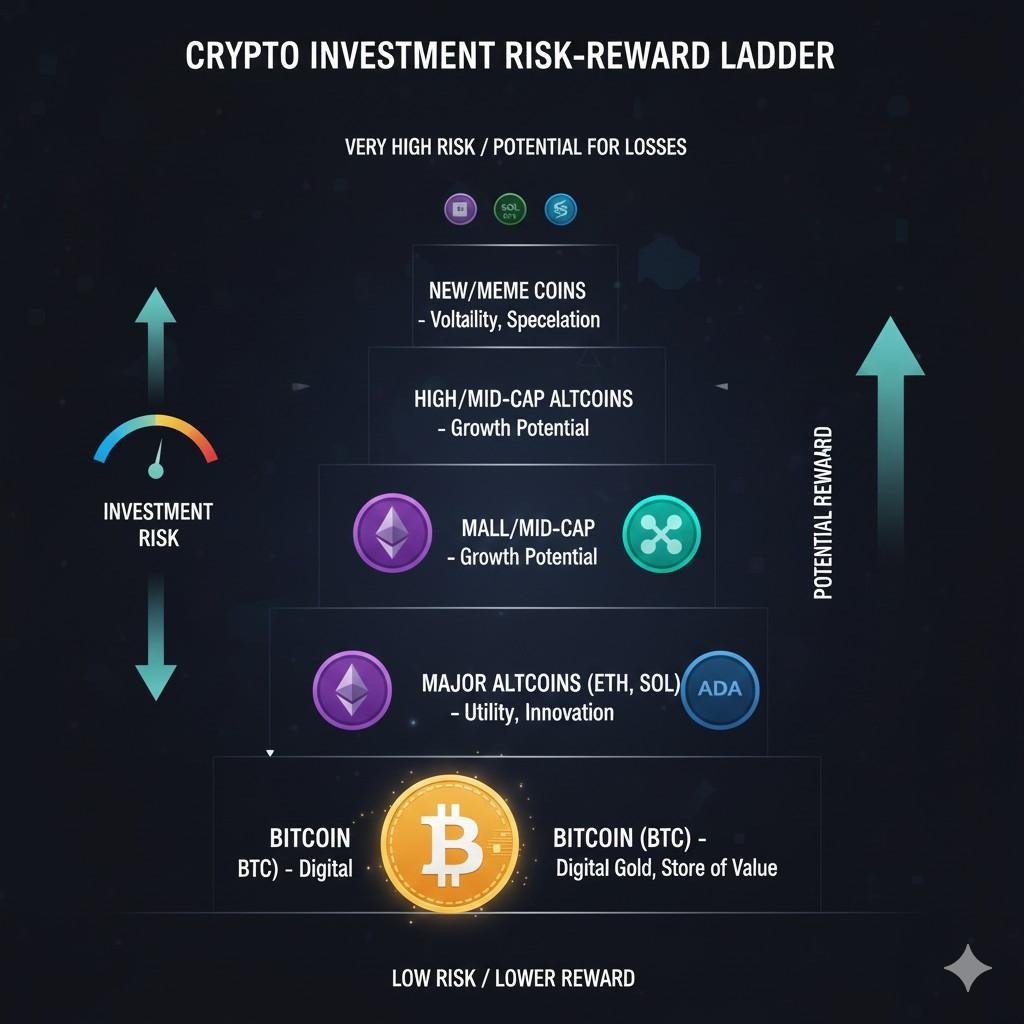
- Lower volatility (relative)
- Institutional adoption
- Long-term stability
Altcoin Risk Level
- Higher volatility
- Bigger upside potential
- Higher failure risk
Bitcoin is considered safer, while altcoins are considered higher-risk, higher-reward.
9. Market Dominance & Liquidity
Bitcoin usually holds 40–50% of total crypto market value.
Advantages:
- Highest liquidity
- Easier to buy/sell
- Lower manipulation risk
Altcoins often depend on market sentiment and hype cycles.
10. Real-World Examples
Example 1: Bitcoin as Digital Gold
Companies like MicroStrategy and Tesla have added Bitcoin to their balance sheets.
Example 2: Ethereum in DeFi
Platforms like Uniswap and Aave run entirely on Ethereum.
Example 3: Solana in NFTs
Many NFT marketplaces prefer Solana for low fees and speed.
These examples make the difference between Bitcoin and altcoins explained very practically.
11. Comparison Chart: Bitcoin vs Altcoins
| Feature | Bitcoin | Altcoins |
| Launch Year | 2009 | 2011+ |
| Supply Limit | Fixed (21M) | Varies |
| Use Case | Store of value | Utility & apps |
| Risk | Lower | Higher |
| Innovation Speed | Slow | Fast |
| Institutional Trust | High | Medium |
12. Future Predictions (2026 & beyond)
Bitcoin Future
- Strong hedge against inflation
- Increased ETF and institutional adoption
- Possible role in national reserves
Altcoin Future
- Fewer but stronger projects
- Regulation will eliminate weak coins
- Utility-based altcoins will survive
The difference between Bitcoin and altcoins explained becomes more important as regulation increases.
13. Which Is Better for Beginners?
For beginners:
- Start with Bitcoin
- Add altcoins gradually
- Avoid hype-driven coins
A balanced portfolio often includes:
- 60–70% Bitcoin
- 30–40% top altcoins
14. Final Verdict
Bitcoin and altcoins are not competitors they are complements.
- Bitcoin offers stability and trust
- Altcoins offer innovation and growth
Understanding the difference between Bitcoin and altcoins explained allows smarter, safer investment decisions.
If Bitcoin is the foundation of crypto, altcoins are the expanding ecosystem built on top of it.
15. FAQs
Q1. Is Bitcoin safer than altcoins?
Yes, Bitcoin is generally safer due to its security, adoption, and limited supply.
Q2. Can altcoins outperform Bitcoin?
Yes, but they carry higher risk.
Q3. Should beginners buy altcoins?
Beginners should start with Bitcoin and slowly explore altcoins.
Q4. Will altcoins replace Bitcoin?
Highly unlikely. Bitcoin’s role as digital gold is unique.
16. Disclaimer
This article is for educational purposes only and does not constitute financial advice. Cryptocurrency investments are risky. Always do your own research before investing.