
Table of Contents
Quick Intro (Short, Snackable)
Confused about how does blockchain wallet work? This simple guide explains public keys, private keys, how transactions get verified, and how your crypto stays safe — in clean, clear, anyone can understand.
1. What Is a Blockchain Wallet?
Let’s get one thing clear:
How does blockchain wallet work
A blockchain wallet does not store your crypto inside the app.
Your Bitcoin, Ethereum, or USDT never leave the blockchain.
What your wallet stores are keys — digital keys that prove you own that crypto.
Think of a blockchain wallet like a remote you use to access your digital money.
The money isn’t in the remote —
it’s in the blockchain network.
Your wallet is simply the access tool.
2. How does Blockchain Wallet Works (Simple Explanation)
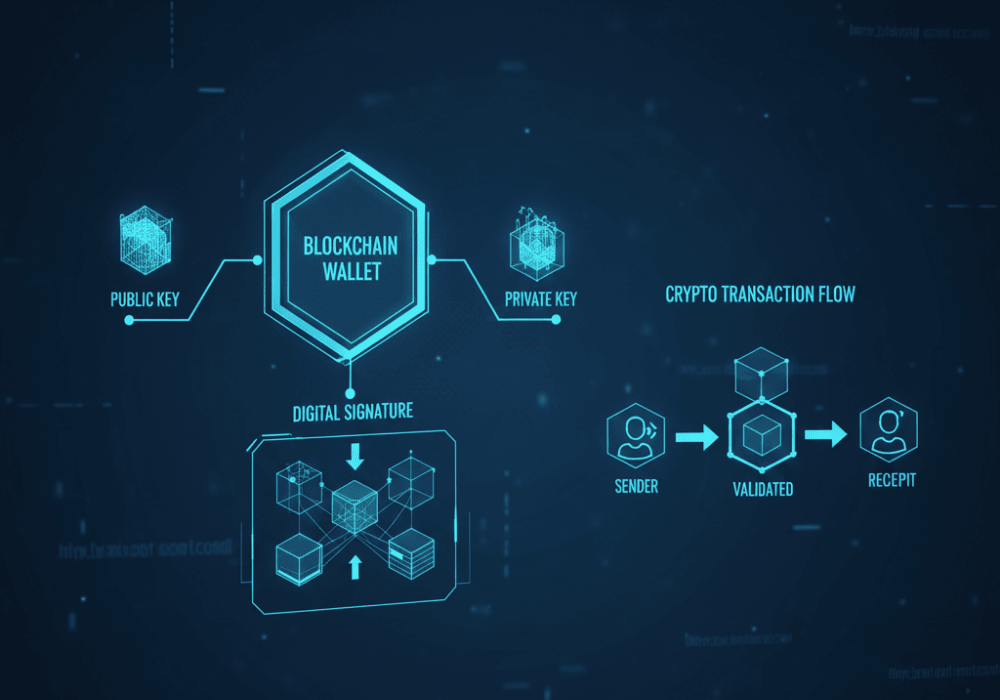
A blockchain wallet works on a two-key system:
✔ Public Key
✔ Private Key
Together, they create a secure digital lock.
Here’s the simplest way to understand how does blockchain wallet work:
- Your public key is like your bank account number.
- Your private key is like your ATM PIN.
The public key is for receiving money.
The private key is for approving transactions.
Your wallet uses the private key to sign every outgoing transaction—
a digital “signature” that says yes, I approve this.
This signature is verified by the blockchain network.
No bank.
No paperwork.
Just cryptography.
3. Public Key vs Private Key
Let’s break them down in easy words.
Public Key (Wallet Address)
Use it for receiving crypto.
- You can share it anywhere
- It looks long and random
- Example:
0xA8F3…2C1D
People send funds to this address.
Private Key
This is the master key to your money.
- Never share it
- Anyone who gets it can empty your wallet
- Example:
5K9d813…pM2Q1
Most wallets convert private keys into a:
✔ 12-word or 24-word Seed Phrase
This is your backup.
Example:
“river shield music forest alpha…”
If you lose your device, this seed phrase restores your wallet anywhere.
Lose the seed phrase?
You lose everything.
4. What Really Happens During a Crypto Transaction
Let’s say you’re sending 0.01 BTC.
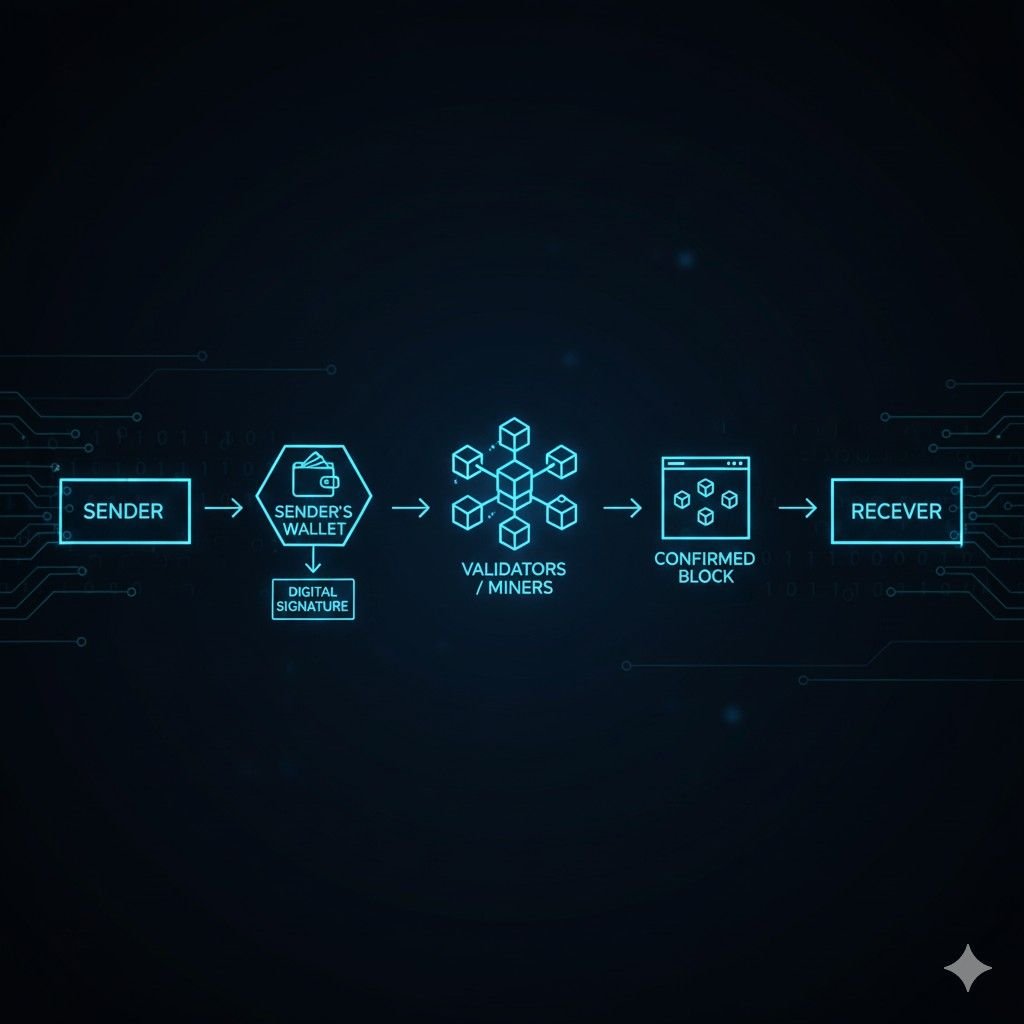
Here’s what happens step-by-step:
1. You enter the receiver’s address
Your wallet creates a transaction draft.
2. Your private key signs the transaction
This proves:
“You own the BTC and approve the transfer.”
3. The signed transaction is broadcast to the blockchain
Nodes pick it up.
4. Miners/validators confirm it
Once verified, it gets added to the blockchain.
5. Both balances update
Your BTC reduces.
Receiver gets the coins.
No bank, no delays, no approvals.
5. Types of Blockchain Wallets
There are several types — each suited to different needs. so how does blockchain wallet work.
1. Software Wallets (Apps/Browser Extensions)
Most popular.
Examples:
- MetaMask
- Trust Wallet
- Coinbase Wallet
- Exodus
Perfect for beginners.
2. Hardware Wallets (Physical Devices)
USB-like tools that store your keys offline.
Examples:
- Ledger Nano X
- Trezor Model T
Safest option for long-term holding.
3. Web Wallets
Browser-based access.
Examples:
- Blockchain.com Wallet
- Binance Wallet
Convenient but requires trust in third-party platforms.
4. Paper Wallets
Printed QR codes of public + private keys.
Safe from online hacks but easy to lose.
6. Hot Wallets vs Cold Wallets
Let’s make it very simple.
Hot Wallets
Connected to the internet.
✔ Easy to use
✔ Free
✔ Best for daily transactions
Examples:
MetaMask, Trust Wallet
Cold Wallets
Offline storage.
✔ Harder to hack
✔ Best for large amounts
✔ Great for long-term investors
Examples:
Ledger, Trezor
Use a hot wallet for spending and a cold wallet for saving — like a digital savings account + pocket wallet combo.
7. How Blockchain Wallets Keep Your Money Safe
Even though wallets look simple, their security is extremely advanced.
✔ Cryptographic Signatures
Every transaction is signed, making it nearly impossible to fake.
✔ Decentralization
No central authority controls your funds.
✔ No single point of failure
Even if your phone breaks, seed phrase = full recovery.
✔ Public ledger transparency
Anyone can verify transactions.
This is why blockchain is trusted by millions worldwide.
8. Common Risks & How to Avoid Them
Crypto wallets are secure —
but users often make mistakes.
Here are the biggest risks:
❌ Storing seed phrase online
❌ Clicking fake wallet links
❌ Sharing private keys
❌ Using public WiFi
❌ Downloading fake apps
❌ Saving seed phrase screenshots
To stay safe:
✔ Write seed phrase on paper
✔ Use official wallet sites
✔ Enable fingerprint/Face ID
✔ Don’t connect wallet to unknown dApps
✔ Use cold wallets for big funds
You don’t need to be scared —
just be careful.
9. Real Example: How a Wallet Transaction Happens
Let’s say Aarav wants to send 0.05 ETH to Neha.
1. Aarav opens MetaMask
Balance: 1.4 ETH
2. He enters Neha’s address
0xB9123…AA42
3. MetaMask shows gas fee
Estimated: 0.0007 ETH
4. Aarav confirms
His private key signs it.
5. Transaction goes to Ethereum validators
They verify and approve.
6. Funds appear in Neha’s wallet
Aarav: 1.3493 ETH
Neha: +0.05 ETH
Simple, transparent, 100% digital.
10. Future of Blockchain Wallets (2025–2030)
The next five years will completely transform wallets.
✔ Account Abstraction
No more private keys — simple logins.
✔ Social Recovery
Recover wallet using trusted contacts.
✔ AI Security Layers
Automatic scam detection.
✔ Multi-chain wallets
One wallet for all blockchains.
✔ Biometric crypto wallets
Face unlock for every transaction.
Wallets will feel like UPI for Web3 — fast, friendly, and secure.
11. FAQs
Q1. Are blockchain wallets free?
No. Seed phrase is mandatory.
Q2. Can I recover my wallet without seed phrase?
Yes, most are free. Only hardware wallets cost money.
Q3. Which wallet is best for beginners?
Trust Wallet or MetaMask.
Q4. Are wallet apps safe?
Yes — if you secure your seed phrase and avoid fake links.
Q5. Can I keep multiple wallets?
Absolutely. You can create unlimited wallets.
12. Conclusion
How does blockchain wallet work it might look complex, but it’s actually quite simple.
It does not store your crypto — it stores the keys that let you access your crypto on the blockchain.
Now you understand:
✔ how public & private keys work
✔ how transactions get signed
✔ why seed phrases are important
✔ hot vs cold wallets
✔ wallet safety in 2025
Once you learn the basics, using a blockchain wallet becomes as easy as using any digital payment app.
You are now ready for Web3.