

Market volatility can wipe out years of hard-earned money in just a few weeks — but smart investors don’t panic, they prepare.
Whether markets crash due to inflation, war, interest rate hikes, or global uncertainty, one thing remains constant: a safe portfolio always survives.
In this complete guide, you will learn how to build a safe portfolio during market volatility using proven strategies followed by successful long-term investors.
Table of Contents
1️. What Is Market Volatility?
Market volatility refers to how quickly and sharply prices move up or down in the stock market over a short period of time. High volatility means big price swings; low volatility means stable prices.
These fluctuations can be caused by some factors:
- Interest rate changes
- Inflation data
- Economic slowdowns
- Global conflicts
- Policy decisions by central banks
- Corporate earnings surprises
Simple Explanation
- 📉 High volatility = market goes up and down very fast
- 📈 Low volatility = market moves slowly and steadily
Volatility is normal, but fear-driven decisions during volatility are dangerous.
Understanding how to build a safe portfolio during market volatility begins with accepting that volatility is unavoidable.
2️. Why Most Investors Lose Money During Volatile Markets
A volatile market is a situation where stock prices move up and down sharply and frequently within a short period of time. These sudden price swings create uncertainty, fear, and also opportunities for smart investors.
Most investors fail not because markets crash — but because they panic.
Common reasons people lose money:
- Emotional selling at market bottoms
- Overexposure to risky stocks
- No diversification
- No exit strategy
- Chasing short-term trends
Causes of a Volatile Market
A market becomes volatile due to:
- Interest rate hikes (RBI / US Fed)
- High inflation
- Economic slowdown or recession fears
- Global wars or geopolitical tensions
- Weak corporate earnings
- Sudden government policy change
Example of a Volatile Market
If Nifty moves:
- 22,000 → 21,200 → 22,500 within days
This rapid movement signals a volatile market.
A safe portfolio is designed before volatility hits, not during it.

3️. Core Principles of a Safe Portfolio
To understand how to build a safe portfolio during market volatility, you must follow these core principles:
✅ Capital Protection Comes First
Returns are secondary. Protecting capital ensures survival.
✅ Risk-Adjusted Returns Matter
High returns with high risk can destroy portfolios quickly.
✅ Long-Term Thinking Wins
Time in the market beats timing the market.

4️. Asset Allocation: Your First Line of Defense
Asset allocation decides where your money goes, and it’s the most important factor in portfolio safety.
🔹 Ideal Asset Allocation Example for Moderate Investor
| Asset Class | Allocation |
| Equity (Stocks) | 40–50% |
| Debt (Bonds, Fixed Income) | 25–35% |
| Gold | 10–15% |
| Cash | 5–10% |
This structure reduces downside risk while allowing growth.
If you truly want to know how to build a safe portfolio during market volatility, start with asset allocation — not stock picking.
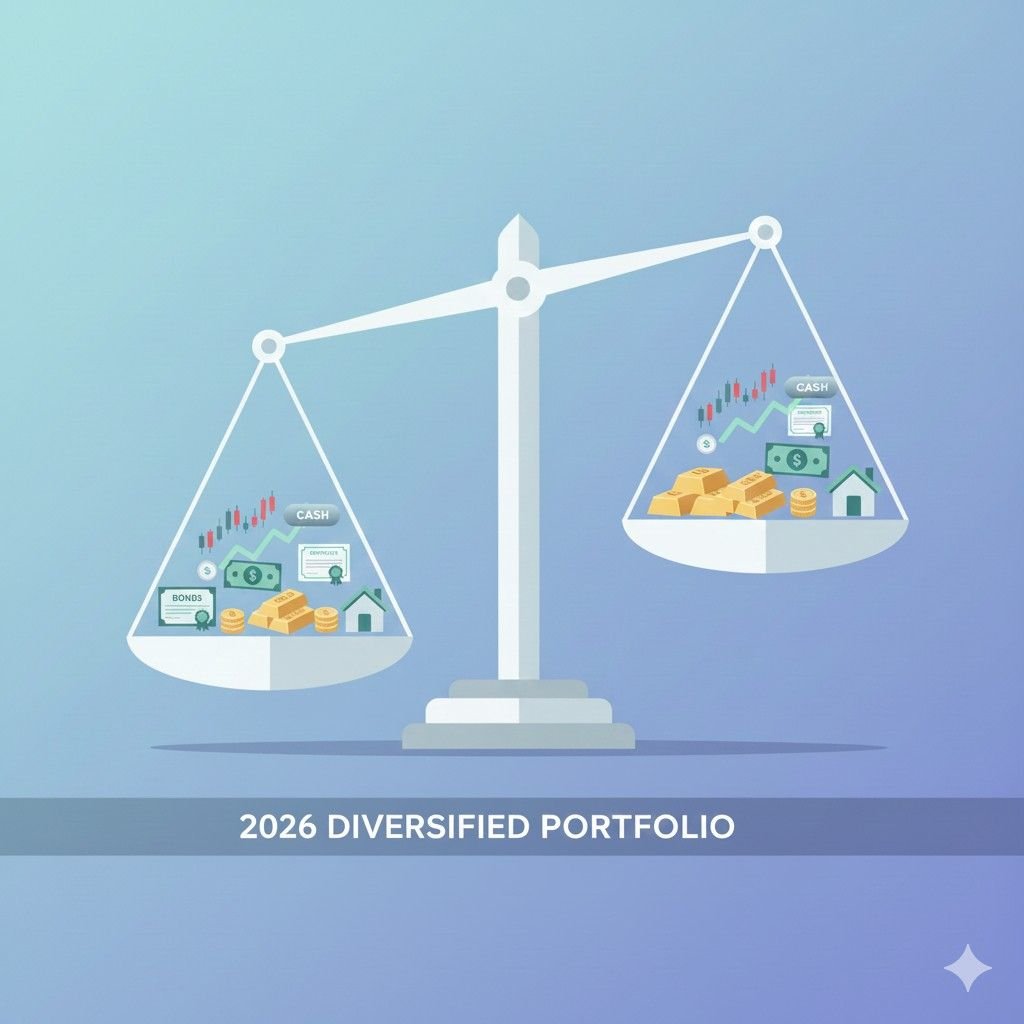
5️. Diversification: Don’t Put All Eggs in One Basket
Diversification is one of the most powerful and safest investing principles. It means spreading your money across different assets so that a loss in one investment does not destroy your entire portfolio.
“Do not put all your eggs in one basket.” – This is diversification in simple words.
Diversification protects you from single-point failure.
Types of Diversification:
- Across sectors (IT, Pharma, FMCG, Banking)
- Across asset classes (Stocks, Bonds, Gold)
- Across geographies (India + US exposure)
- Across market caps (Large-cap, Mid-cap)
A diversified portfolio falls less and recovers faster.
6️. Defensive Assets That Protect Your Capital
Certain assets perform better during uncertain times.
🛡️ Defensive Assets Include:
🟢 Large-Cap Stocks
Stable companies with strong balance sheets.
🟢 Debt Instruments
- Government bonds
- Corporate bonds
- Debt mutual funds
🟢 Gold
Acts as a hedge against inflation and currency risk.
🟢 Low-Volatility Funds
Designed to reduce fluctuations during market stress.
Including these assets is essential when learning how to build a safe portfolio during market volatility.
7️. Role of Cash and Emergency Funds
Cash is not useless — it is strategic power.
Benefits of Holding Cash:
- Avoid forced selling
- Buy quality assets at lower prices
- Reduce emotional stress
Rule:
Keep at least 6–12 months of expenses in liquid assets.
A safe portfolio always includes liquidity.
8️. How SIPs and Dollar-Cost Averaging Reduce Risk
Systematic Investment Plans (SIPs) are extremely effective during volatile markets.
Why SIPs Work:
- Buy more units when prices fall
- Reduce average cost
- Remove emotional timing errors
Volatility actually benefits disciplined SIP investors.
If you’re serious about how to build a safe portfolio during market volatility, SIPs should be non-negotiable.
9️. Common Mistakes to Avoid During Volatility
🚫 Panic selling
🚫 Overtrading
🚫 Leverage and margin trading
🚫 Chasing social media tips
🚫 Ignoring asset allocation
Markets punish impatience and reward discipline.
10. Long-Term Mindset: The Ultimate Protection
History proves that one thing clearly:
Markets always recover — weak portfolios do not recovered.
Long-term investors who stay invested during crashes often achieve the best returns.
A safe portfolio is built for:
- 5–10 year horizons
- Wealth preservation
- Stress-free investing
This mindset completes your understanding of how to build a safe portfolio during market volatility.
📊 Quick Checklist: Safe Portfolio Framework
✔ Proper asset allocation
✔ Diversification across assets
✔ Defensive instruments included
✔ Adequate cash buffer
✔ SIP-based investing
✔ Long-term focus
11. Final Verdict
Market volatility is unavoidable, but losses are optional.
If you master how to build a safe portfolio during market volatility, you won’t fear crashes — you will use them as opportunities.
Safe investing is not about prediction.
It is about preparation, patience, and protection.
12. FAQs
Q1. Can I completely avoid losses during market volatility?
No, but a safe portfolio minimizes losses and recovers faster.
Q2. Is gold really necessary in a portfolio?
Yes, gold provides stability during equity market downturns.
Q3. Should I stop SIPs during market crashes?
No. Continuing SIPs during crashes improves long-term returns.
Q4. Are mutual funds safer than stocks during volatility?
Diversified mutual funds generally carry lower risk than individual stocks.
Q5. How often should I rebalance my portfolio?
Once or twice a year is sufficient.