
What if a single RBI announcement could add or wipe out ₹5 lakh crore from the Indian stock market in just one day?
As India enters 2026, RBI policy decisions are becoming the biggest hidden trigger behind stock market rallies, crashes, and sector rotations. From interest rates to liquidity, from inflation control to growth push — the RBI Policy Impact on Indian Stock Market 2026 is something every investor must understand, whether beginner or pro.
Table of Contents
1. Why RBI Policy Matters More Than Ever in 2026
In 2026, India is no longer a developing economy — it is a global growth engine. With higher foreign investment, expanding retail participation, and rising global uncertainty, RBI policy decisions now carry massive market influence.
The RBI Policy Impact on Indian Stock Market 2026 is stronger because:
- Retail investors dominate daily volumes
- Algo trading reacts instantly to policy words
- FIIs closely track India’s monetary stance
- Inflation and interest rates directly affect corporate profits
A single line in the RBI Governor’s speech can change market sentiment overnight.
2. Understanding RBI’s Role in the Indian Economy
The Reserve Bank of India (RBI) is India’s central bank, responsible for:
- Maintaining price stability (inflation control)
- Supporting economic growth
- Regulating liquidity in the financial system
- Ensuring financial stability
RBI does not directly control stock prices, but its policies create the environment in which markets rise or fall.
This indirect power makes the RBI Policy Impact on Indian Stock Market 2026 extremely powerful.
3. Key RBI Policy Tools That Move the Stock Market
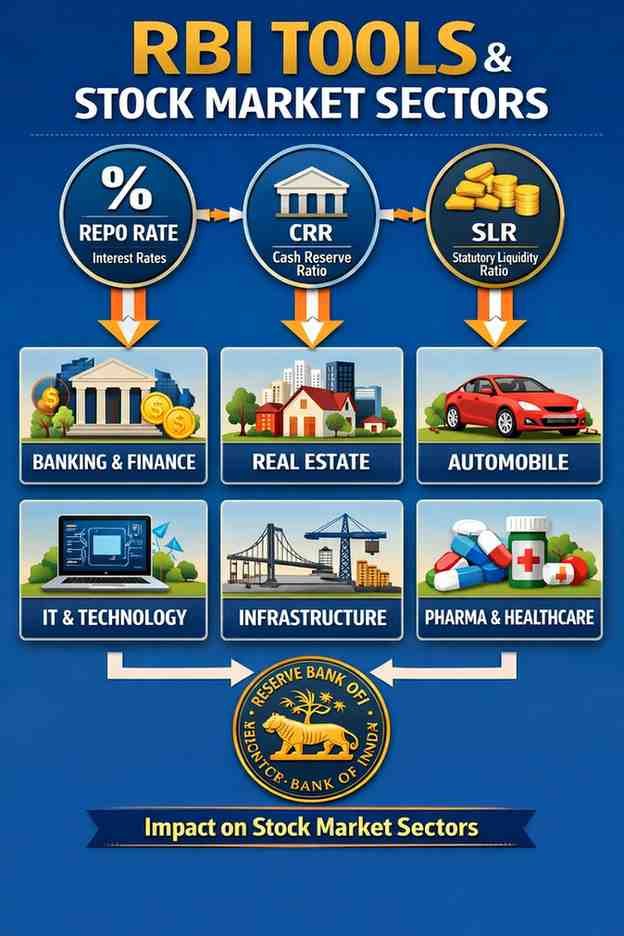
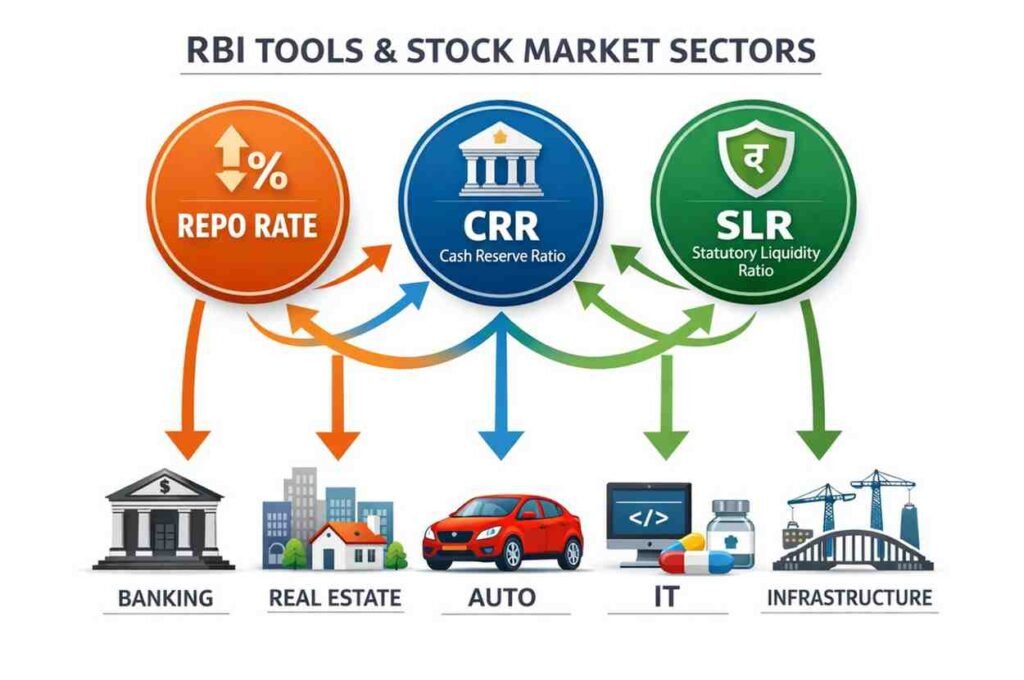
🔹 Repo Rate
The rate at which RBI lends money to banks.
🔹 Reverse Repo Rate
Rate at which RBI borrows money from banks.
🔹 CRR (Cash Reserve Ratio)
Money banks must keep with RBI.
🔹 SLR (Statutory Liquidity Ratio)
Mandatory holdings of government securities.
🔹 Open Market Operations (OMOs)
Buying or selling government bonds.
Each of these tools directly affects liquidity, borrowing costs, and investor confidence.
4. Interest Rate Decisions & Market Reactions
Interest rates remain the single most powerful trigger in 2026.
When RBI Cuts Rates:
- Borrowing becomes cheaper
- Corporate profits improve
- Stock markets usually rally
- Real estate & banking stocks outperform
When RBI Hikes Rates:
- Loan EMIs increase
- Consumption slows
- Stock markets turn cautious
- FMCG & IT become defensive bets
Historically, every major rally in India has followed stable or falling interest rates — proving the RBI Policy Impact on Indian Stock Market 2026 is deeply linked to rate cycles.
5. Inflation Control vs Market Growth
RBI walks a tightrope between inflation control and economic growth.
In 2026:
- High inflation → Tight monetary policy
- Controlled inflation → Growth-friendly policy
Why Inflation Matters to Stocks:
- High inflation reduces purchasing power
- Input costs rise for companies
- Profit margins shrink
- Valuations correct
When RBI successfully controls inflation without killing growth, markets reward it with strong bull runs.
6. Liquidity, Money Supply & Stock Market Trends
Liquidity is the fuel of bull markets.
High Liquidity Environment:
- More money flows into equities
- Mid-cap and small-cap stocks boom
- IPO markets remain active
Low Liquidity Environment:
- Markets become volatile
- Defensive stocks outperform
- Valuations compress
In 2026, RBI’s liquidity management policies decide whether India sees a broad-based rally or selective growth.
This is another major angle of the RBI Policy Impact on Indian Stock Market 2026.
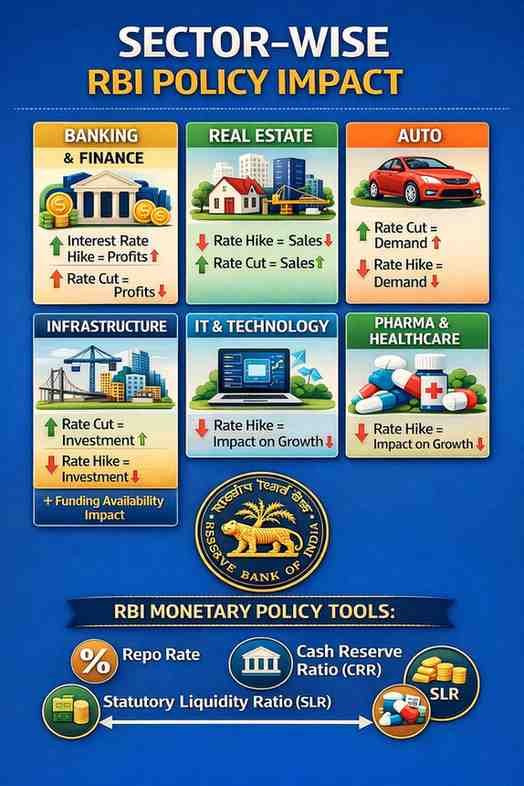
7. Sector-Wise Impact of RBI Policy in 2026
🏦 Banking & Financial Stocks
- Most sensitive to RBI policy
- Benefit from stable interest rates
- Strong credit growth boosts profits
🏗 Infrastructure & Capital Goods
- Gain from growth-oriented policies
- Low rates increase project viability
🏠 Real Estate
- Rate cuts → Big rallies
- Rate hikes → Demand slowdown
💻 IT & Export Stocks
- Indirectly affected via currency & global cues
- Defensive during tight policy cycles
🛒 FMCG
- Stable performer
- Benefits from inflation control
Smart investors in 2026 track RBI policies sector-wise, not just index movements.
8. RBI Policy and Foreign Institutional Investors (FIIs)
FIIs are extremely sensitive to:
- Interest rate differentials
- Currency stability
- Inflation outlook
A hawkish RBI stance can:
- Strengthen the rupee
- Attract long-term foreign capital
A growth-focused RBI stance can:
- Boost equity inflows
- Increase market valuations
The RBI Policy Impact on Indian Stock Market 2026 is incomplete without understanding FII behavior.
9. Bull Market vs Bear Market: RBI’s Hidden Influence
Most investors blame:
- Global markets
- US Fed
- Geopolitical tensions
But RBI policy quietly decides:
- Market bottoms
- Market tops
- Trend reversals
A stable RBI policy often signals the start of a bull market, while aggressive tightening has historically marked market corrections.
10. Long-Term Investors vs Traders: Who Benefits More?
Long-Term Investors:
- Benefit from predictable policy
- Can accumulate during rate hikes
- Enjoy compounding in stable environments
Traders:
- Profit from volatility around policy days
- RBI announcements create sharp intraday moves
Both groups must understand the RBI Policy Impact on Indian Stock Market 2026 to survive and grow.
11. What Investors Should Do After RBI Policy Announcements
✅ Read the policy statement, not just headlines
✅ Watch RBI’s tone: Hawkish vs Dovish
✅ Observe bond market reaction
✅ Track banking and rate-sensitive stocks
✅ Avoid emotional buying or selling
Smart money reacts after clarity, not during panic.
12. Expert Predictions: RBI Policy Outlook for 2026
Most analysts expect:
- Balanced approach between growth and inflation
- Focus on financial stability
- Support for credit growth
- Gradual policy adjustments, not shocks
This creates a structurally bullish environment for Indian equities, with selective volatility.
13. Final Verdict: Is RBI the Real Market King?
Yes — quietly, consistently, and powerfully.
The RBI Policy Impact on Indian Stock Market 2026 proves that:
- RBI doesn’t chase markets
- Markets chase RBI
Understanding RBI policy is no longer optional — it’s a core investing skill in modern India.
14. Disclaimer
This article is for educational purposes only. Stock market investments are subject to market risks. Always do your own research or consult a financial advisor.
15. FAQs: RBI Policy Impact on Indian Stock Market 2026
Q1: Why is RBI policy so important for stocks in 2026?
Because RBI decisions on rates and liquidity directly decide market direction and volatility.
Q2: Do RBI rate cuts always boost the stock market?
Mostly yes, but sector-wise impact matters more than index movement.
Q3: Which stocks react fastest after RBI policy announcements?
Banking, NBFC, real estate, and rate-sensitive stocks move first.
Q4: Should investors trade immediately after RBI policy news?
Experts suggest waiting for clarity instead of reacting emotionally.
Q5: How does RBI policy affect foreign investors?
Stable RBI policy attracts long-term FII inflows into Indian markets.
Q6: Can RBI policy create a bull market in 2026?
Yes — supportive policy environments often trigger sustained rallies.